
|
|
A new Queensland wine business, Whiskey Gully Wines, has won four trophies, two gold medals, six silver medals and five bronze medals in the first year of showing its wines. Proprietor John Arlidge explains how… |
| A
week may be a long time in politics but it is a grain of agriculture’s
sands of time, so nobody is more surprised than I am at our relatively
quick success.
Sipping a glass of our own gold medal Cabernet Sauvignon and looking out over acres of mature vines, we still pinch ourselves to make sure that all those awards, only four years since our arrival, are not just a dream. Denice, my wife, Emily, my daughter and I purchased Beverley, an old station property off the New England Highway at Severnlea, just south of Stanthorpe, now down to 260 acres with a fine old 1880’s homestead and good grazing country. We put a few weaner cattle on the block and set about establishing a vineyard and wine tourism business. Having
no previous farming experience, we hired a local consultant and armed ourselves
with every book on the subject we could find. Within four months we had
planted our first four acres of vines and, like thousands of others since
the dawn of time, became thoroughly fascinated with turning sunlight into
wine.
|
To
be successful, we reasoned that we would need to produce premium wines
because there is little space and even less water on the Granite Belt,
meaning you need to maximise the value of your plantings.
It is one of Australia’s smallest wine growing regions in a narrow valley 800 metres up on the Great dividing range. Vines, stone fruit and vegetables are planted in any space anyone can find among the granite boulders. If there were a market for rocks Granite belt farmers would be wealthy.  |
| Those
first four acres were planted carefully, with every benefit modern viticulture
could bestow, including grafted rootstocks, permanent weed-matting laid
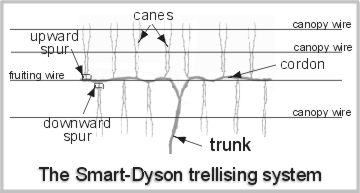
down the row and a Smart-Dyson canopy management system.
One of the challenges of viticulture – and part of its fascination – is that there are many “right” ways of doing things. Viticulturists make critical judgements based on reasoning, experience and conditions specific to the vineyard such as soil types, available water and drainage. In the Granite Belt, for example, soils are poor, which vines quite enjoy, although it is one reason why yields in this area are often low. Top and sub soils are decomposed granite. They drain well and promote vine root development but they are rarely more than a metre deep over impermeable clay. |
Our
judgement was that if we wanted good yields (four tonnes per acre) of high
quality fruit then we would need vigorous rootstocks and a trellising system
that opened the canopy to sunlight.
The late professor Nelson Shaulis, of Cornell University, began research fifty years ago that led to a vineyard revolution. He questioned why in France and elsewhere vineyards with low vigour and poor yields produced the best wines and eventually he was able to demonstrate that too much shading from a vigorous canopy prevented fruit ripening properly. Later, a retired NASA engineer influenced by Shaulis developed the eponymous Scott Henry trellis. The Smart-Dyson trellis that Whiskey Gully Wines adopted is a development of this and was invented by a former Australian student of Shaulis, Dr Richard Smart, and an American colleague John Dyson. |
| This
system requires vines to be trained to a single horizontal cordon. Spurs
on the cordon are then trained both upwards and downwards and the canes
from these are held vertical by sets of canopy wires (see figure 1).
We
went one step further. I was concerned about the potential impact of having
canes and leaves hanging down and trailing among weeds on the ground.
|
I
reasoned that this might act as a conduit for disease during wet summers
(although Richard Smart, now a globe trotting consultant and a formidable
fund of viticultural knowledge, thoroughly disagrees with me on this point.)
The solution to this perceived problem was to lay permanent weed-matting along the row through which we could irrigate and which would provide a guaranteed weed-free zone. It worked. In fact the mulching effect of the matting improved water retention in the soil and enhanced the efficiency of our irrigation. So, my disease theory notwithstanding, the matting proved itself. The result was four acres of wonderfully healthy vines. In the 2000 Vintage, just two and a half years after planting, wine from their sweet berries won 17 trophies and medals, including two gold medals in 2001.
|
| Whiskey
Gully Wines’ initial plantings were intended to prove that the property
would support premium wine grapes. They clearly achieved that - even more
than my high expectations, in fact.
Meanwhile, we had renovated the old homestead into a restaurant and built two up-market holiday cottages on the property. A modest cash stream trickled in. Since then we have had another successful and larger vintage; we have planted two additional acres of vines; and we are looking this season at a bumper 18 to 20 tonnes of quality fruit including Cabernet Sauvignon, Shiraz, Chardonnay and Colombard. For us, this is the end of the beginning. It was always our intention to expand the vineyard and to build a winery – we have about eighty acres of land suitable for planting – and that is our next challenge. We
are putting the finishing touches to a three-stage/10 year business plan
and will soon be inviting one or two lead investors to participate.
|
Ultimately,
the plan is for Whiskey Gully Wines to be a medium-sized wine and tourism
business crushing up to 1000 tonnes per annum and listed on the stockmarket.
As you may imagine, none of what has been achieved has come without considerable effort and investment – to be honest, probably more of the former than we ever imagined. It is an abiding amusement that four years ago our friends in Brisbane waved us off and wished us well in our “retirement”. Fours years on we have never been busier and there has never been more to do. So I must get on. If anyone would like to know more about our little enterprise, do give us a call or look up our web site: www.whiskeygullywines.com.au. If you would like to know more about viticulture Richard Smart’s web site is a fund of knowledge: www. smartvit.com.au.
|